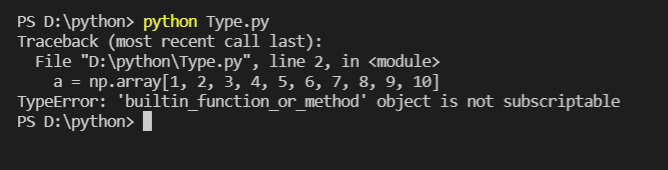
Okay, folks, let's talk about something that's tripped up every coder at least once: the dreaded TypeError: 'builtin_function_or_method' object is not subscriptable. Sounds scary, right? Like some kind of alien invasion in your Python code. But trust me, it's more like accidentally trying to use a spoon to cut your steak – frustrating, but ultimately solvable.
What in the World Does That Mean?
Think of it this way. Imagine you're trying to order a pizza. You want the ingredients, right? The toppings. In Python, "subscripting" is like asking for a specific ingredient from a list (or, you know, a pizza). You use square brackets, like my_list[2] to get the third item.
Now, a "builtin_function_or_method" is like the whole pizza-making process itself. It's a pre-made function that Python gives you, like len() to find the length of a string or list, or print() to show something on the screen. It's the action and not the thing.
Must Read
So, the error basically says: "Hey! You're trying to treat a pizza-making process like it's a list of ingredients. You can't ask for the 'second ingredient' of the pizza-making process. That makes no sense!"
I know, I know. It sounds convoluted. But it gets easier, promise!
 Unraveling 'Set' Object: The Essence Of Non-Subscriptability
The Usual Suspects: How This Happens
The most common culprit? Forgetting parentheses! Let's say you want to get the length of a string. You should use len(my_string). But if you accidentally type len[my_string], Python will throw that "builtin_function_or_method" error at you, and it'll feel like a personal attack.
It's like trying to start your car by yelling "Engine!" at it. You need to do something to the engine, like turn the key!
 How to fix TypeError: 'method' object is not subscriptable | sebhastian
Another classic is trying to access a method without calling it first. For example, if you have a string called my_string, you want to use the lower() method to convert it to lowercase. You need to call it with parentheses: my_string.lower(). Writing just my_string.lower is like holding a phone but not dialing the number. You're just... holding a potential connection.
I’ve definitely spent way too long staring at code like my_string.lower[0] before realizing I needed to call the method first and then get the first character: my_string.lower()[0].
 Top 15 'Float' Object Is Not Subscriptable Update
Debugging Tips: Be the Code Detective
So, how do you catch this little bugger? Here’s your detective toolkit:
- Look for Missing Parentheses: This is the most common cause. Double-check your
len()s, yourprint()s, and any method calls. Is there a stray square bracket where there should be parentheses? - Check Your Method Calls: Are you trying to access something on a method without calling it first? Remember, methods are actions, so they need those parentheses.
- Read the Error Message Carefully: Okay, sometimes error messages in programming can be cryptic. But in this case, the message is pretty direct. It tells you that you're trying to subscript a "builtin_function_or_method".
Example Time!
Let's say you have this code:
![[Solved] TypeError: method Object is not Subscriptable - Python Pool](https://www.pythonpool.com/wp-content/uploads/2021/05/Solved-TypeError-‘method-Object-is-not-ubscriptable.jpg) [Solved] TypeError: method Object is not Subscriptable - Python Pool
[Solved] TypeError: method Object is not Subscriptable - Python Pool
  my_list = [1, 2, 3]
  length = len[my_list]
  print(length)
You'll get the "TypeError: 'builtin_function_or_method' object is not subscriptable" error. Why? Because you're trying to subscript len instead of calling it as a function. The fix is simple:
  my_list = [1, 2, 3]
  length = len(my_list)  # Corrected line!
  print(length)
See? No more error. And now you know how to order your pizza… I mean, write your Python code… correctly.
The Takeaway
This error might seem daunting at first, but it's really about understanding the difference between a function/method and its result. Always remember: parentheses are your friends! And when in doubt, take a deep breath, read the error message carefully, and think about whether you're trying to treat a process like an ingredient. Happy coding!